Six Flooring Types for a Home Office, Compared
A home office floor has three jobs that no other room asks for at once: survive a rolling chair, stay quiet enough for calls, and not throw light back at a camera. Six common options handle those demands very differently, and the chair is the one that decides most of it.
Published 9 min read
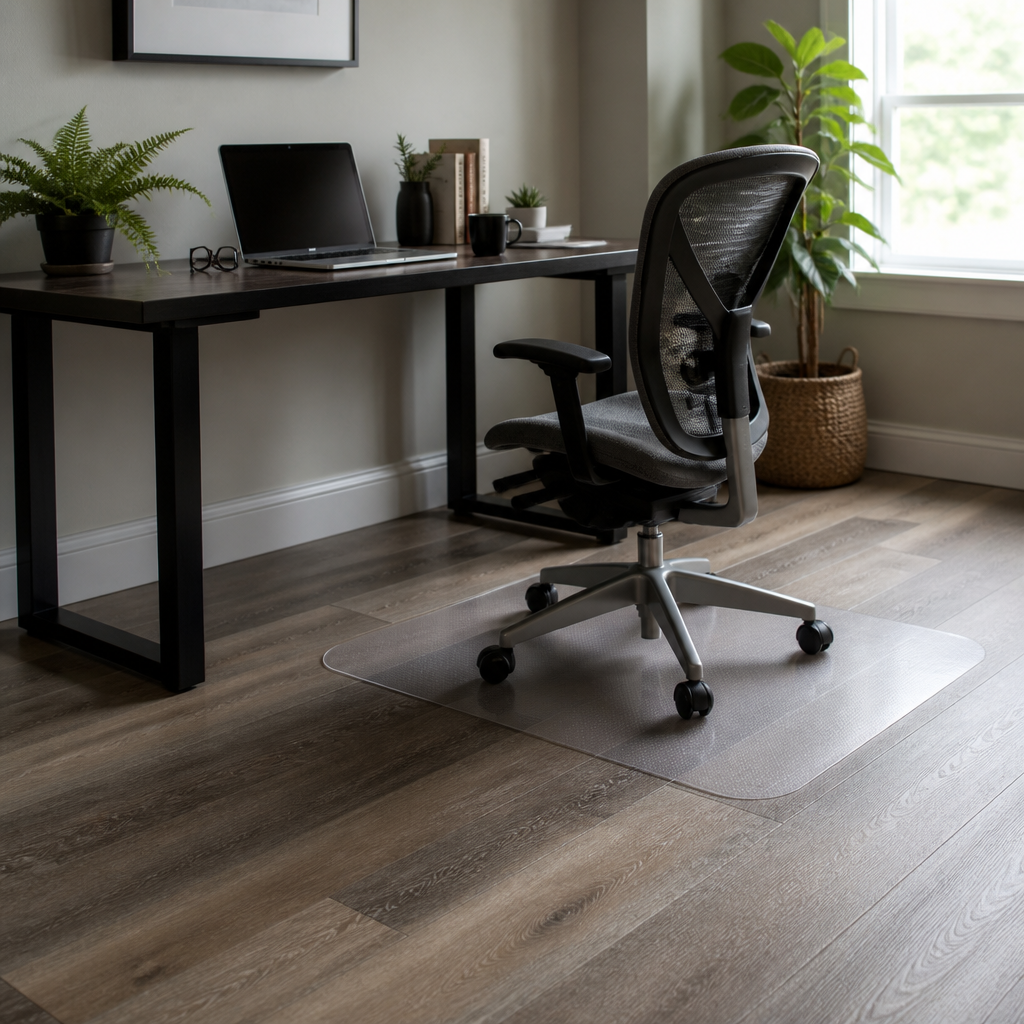
Flooring guides usually rank surfaces by looks and price. A home office is a better test than most rooms, because it applies three specific stresses that expose the difference between a floor that photographs well and a floor that is still presentable in five years.
The three demands
- Caster wear. A desk chair concentrates load on five small wheels and moves them over the same square metre thousands of times a year. It is the most aggressive thing that happens to a residential floor.
- Acoustics. Calls are the main use of the room. A hard, reflective floor lengthens reverberation and makes a microphone sound like a bathroom.
- Light. A glossy floor bounces window light and lamp light upward into the camera, which produces uneven exposure and, at worse, visible reflections.
The six options
1. Luxury vinyl plank and tile
The default answer for a working room, and usually the right one. The specification that matters is the wear layer, measured in mils: heavier wear layers such as 20 mil handle chair casters far better than the 12 mil products sold for light residential use. Warm underfoot, quiet, water tolerant, and it can be repaired plank by plank if it is a click system. Cheap products dent under point loads and can telegraph subfloor irregularities.
2. Laminate
A photographic layer over a fibreboard core, protected by a wear surface graded with an AC rating under the European standard EN 13329, running from AC1 to AC5, with AC3 the usual minimum for anything beyond a bedroom. Hard, scratch resistant, and the loudest of the six under a chair: the core is a drum. It is also the least tolerant of standing water, since the core swells and does not recover.
3. Engineered wood
Real wood veneer over a stable plywood or fibreboard core. The number to ask for is the wear layer thickness in millimetres, because it determines whether the floor can be sanded and refinished later and how many times. Attractive and repairable, dents under casters and under dropped equipment, and the finish sheen you choose matters for on-camera glare.
4. Cork
The acoustic specialist. Warm, quiet, soft underfoot and made from a renewable bark harvest. Compresses under point loads, so a chair without a mat leaves marks, and it needs a maintained finish. Best where calls and comfort matter more than hard wearing surfaces.
5. Carpet tile
The quietest option and the only one you can replace a square of. Modular tiles are made for commercial offices, which means they are specified for chair caster use in a way domestic broadloom generally is not. Less warm and soft than a residential carpet, and the visual seams are either a feature or an irritation. The broader case for carpet is in the benefits of installing carpet.
6. Polished or sealed concrete
On a slab, the most durable surface available and completely indifferent to casters. It is also the hardest, coldest and most acoustically reflective, and a polished finish is the worst of the six for camera glare. It works best when it is broken up by rugs, which is to say when you accept that the rug is doing the acoustic work.
Side by side
| Floor | Casters | Quiet | Warm underfoot | Water | Refinishable | Camera glare |
|---|---|---|---|---|---|---|
| Luxury vinyl plank | Good with a heavy wear layer | Good | Good | Good | No, replace planks | Low to moderate |
| Laminate | Good surface, noisy | Poor | Moderate | Poor | No | Moderate |
| Engineered wood | Moderate, dents | Moderate | Good | Moderate | Yes, depending on wear layer | Depends on sheen |
| Cork | Poor without a mat | Excellent | Excellent | Moderate | Refinish the coating | Low |
| Carpet tile | Good if specified for casters | Excellent | Good | Moderate | Replace tiles | None |
| Polished concrete | Excellent | Poor | Poor | Excellent | Yes | High if glossy |
The chair problem, in detail
Casters are made in two families and they are not interchangeable. Hard casters are intended for soft floors such as carpet; soft, rubberised casters are intended for hard floors. Fitting the wrong one is how a new floor acquires a circular scuff pattern in its first month. Office chair casters follow the European standard EN 12529, which distinguishes type W for hard floors and type H for carpet, and reputable chairs state which they ship with.
- Match the caster to the floor, and buy the alternative set if the chair came with the wrong ones.
- Use a chair mat sized to the actual working area, not the smallest one that fits under the desk.
- On hard floors, choose a mat with a smooth back. Studded backs are for carpet and will mark a hard surface.
- Keep grit off the mat. Grit under a caster is a grinding wheel.
A chair mat costs a fraction of a floor and outlasts three chairs. There is no version of this decision where skipping it is the economical choice.
The cheapest line in the room
Sound and underlayment
Underlayment beneath a floating floor changes both how the room sounds and what the room below hears. A dedicated acoustic underlayment is a small addition at installation and impossible to add later without lifting everything.
That said, the honest hierarchy for call quality is: soft furnishings, then a rug, then the floor construction. A large rug under the desk does more for a microphone than any upgrade in the floor specification, and it can be bought after the fact.
Subfloor and moisture come first
Every floor on this page fails the same way when the layer beneath it is wrong.
- Flatness. Floating floors have a tolerance, stated by the manufacturer, and exceeding it produces flexing joints, hollow sounds and eventually failed locks.
- Moisture in a slab. Test before installing anything, using the method the flooring manufacturer names, and follow their limit rather than a general figure.
- Expansion gaps. Floating floors must be able to move at the perimeter. Trapping one against a wall or a heavy bookcase is a common cause of buckling.
- Point loads. A tall bookcase full of books on a floating floor pins it and stops it moving. Plan where the heavy furniture goes before the floor is laid.
What to skip
High gloss finishes, in any material, because a camera sees them. Very dark floors, which show every speck of dust and every caster mark under a window. And the cheapest tier of any of these products, because in a working room the wear layer is the whole product and it is exactly what the cheapest tier removes.
Once the floor is chosen, the order in which the rest of the room is finished still matters, and the general sequencing rules are in the guide to spending on a house in the right order.